Drone Consultancy

Expert drone consultancy in Australia. We help with ReOC approvals, OONP applications, complex ops planning, and CASA compliance – nationwide.

Industrial cargo drone on the ground beside an operator in open Australian countryside. Medium category flight tests

Flying Glass provides medium RPA operations and holds CASA authorisation to conduct medium category flight tests. If you are preparing to fly a larger drone, you can contact us to arrange an assessment. If you need a drone job carried out, you can hire us to do the flying.

We work with pilots seeking their next qualification and clients who want an experienced operator to deliver a project. Depending on the job, we can operate your drone or provide a suitable aircraft from our own fleet.

Contact Flying Glass about a flight test or drone operation.

Medium Category Flight Tests for Pilots

Our medium category flight testing service is available to pilots ready to demonstrate the competence required for their proposed assessment. You may already fly smaller drones and be preparing to operate a larger aircraft for work, or you may need an assessment for a specific aircraft you intend to use.

Tell us about your current remote pilot licence, relevant experience and intended aircraft. We will confirm the assessment scope and practical requirements, then discuss a suitable appointment.

We welcome enquiries from pilots arranging their own assessment. If you are unsure about your next step, explain what you currently fly and what you are working towards.

Our main assessment base is on the NSW Central Coast, with Sydney appointments available by arrangement. Pilots from elsewhere in Australia are also welcome to come to us.

Enquire about your medium category flight test.

Industrial cargo drone on the ground beside an operator in open Australian countryside. Medium category flight tests

Hire Us to Carry Out Your Drone Project

If your priority is getting the work done, we can provide the operating service. You may have a project that needs completing before you are ready to fly it yourself, or you may prefer to engage a specialist operator when the need arises.

Flying Glass undertakes medium RPA work for clients, with the aircraft and operating arrangements agreed around the job. This can be useful for a one-off project, occasional work or an organisation that wants to outsource the flying.

Tell us what you need to achieve, where the work will take place and your preferred timing. We will review the requirements and confirm the service we can provide.

We Can Fly Your Drone

If you already have a medium RPA, you can enquire about engaging us to operate it for your project. Include the aircraft details, its proposed configuration and an outline of the work.

We will discuss the aircraft’s suitability, the relevant documentation and the arrangements needed to carry out the operation. This gives you an option to put an existing aircraft to work with professional operational support.

We Can Provide the Drone and Operator

If you need both the aircraft and the flying service, tell us about your project and any payload or output requirements. We can discuss supplying a suitable drone from our fleet and carrying out the work for you.

You can enquire without having selected an aircraft. Start with the result you need, and we will establish whether we can provide an appropriate aircraft and operating arrangement.

Tell us about the drone work you need completed.

Planning Medium RPA Operations Around Your Project

The useful starting point for a commercial enquiry is the work itself. The aircraft, location, people involved and required outcome all influence how an operation should be planned.

For example, an aircraft you already own may suit the project, or the work may call for a different configuration. A proposed site may also have access, airspace or scheduling considerations that need to be addressed before a date can be confirmed.

When you contact us, include:

  • The job: what you want the drone operation to achieve.
  • The location: the site or area where the flying is required.
  • The timing: your preferred date, timeframe or project deadline.
  • The aircraft: whether you have a drone available or need us to supply one.
  • The result: any payload, output or delivery requirements you already know.

You do not need to have a complete aviation brief before getting in touch. A clear description of the job lets us ask the relevant questions and work through the options with you.

Flight Testing and Commercial Operating Requirements

A pilot assessment and a commercial drone operation have different purposes. The flight test relates to your competence and the relevant pilot qualification. A commercial booking concerns the planning and delivery of a particular job.

CASA distinguishes the remote pilot licence held by a pilot from the ReOC framework for an operator. The permissions required depend on the aircraft and proposed activity.

If you are developing your own commercial capability, our drone consultancy services can also help you work through operational planning, procedures and ReOC considerations. You can raise those questions as part of your enquiry.

Central Coast, Sydney and Projects Across Australia

For flight tests, the Central Coast is our main base and Sydney appointments are available by arrangement. If you are travelling from elsewhere, contact us before booking transport or accommodation so the appointment and assessment requirements can be confirmed.

If several pilots need assessment, you can include their approximate numbers in your enquiry. For larger groups, we can arrange travel to a suitable assessment location elsewhere in Australia.

For commercial drone work, Flying Glass accepts project enquiries from across Australia. Tell us where the job is and when you need it completed so we can discuss availability, aircraft suitability and the operating arrangements.

Choose the Service That Suits Your Next Step

If you want to progress your own flying, enquire about a medium category flight test. If you need a project completed, enquire about our operating service. You can also discuss both if you need support with a job now while working towards your own pilot qualification.

Your enquiry comes directly to Flying Glass. We will help you establish the appropriate next step and provide the details relevant to the service you need.

Frequently Asked Questions

Can I Enquire About a Flight Test as an Individual?

Yes. We welcome enquiries from pilots arranging their own assessment. Tell us about your current licence, relevant experience and intended aircraft, along with your preferred location and timeframe.

Can I Hire You Instead of Flying the Job Myself?

Yes. You can engage Flying Glass to carry out medium RPA work, subject to the project’s requirements. We can discuss using your aircraft or supplying a suitable drone from our own fleet.

Can You Operate a Drone That I Already Own?

Yes, where the aircraft and proposed operation are suitable. Include the aircraft details in your enquiry so we can review the requirements and explain the information needed to plan the work.

Do I Need to Know Which Drone the Project Requires?

No. If you need us to provide the aircraft, describe the work and the result you want. We can discuss suitable options and confirm what we can offer for the project.

How Do I Get Details About Availability?

Use our contact form and tell us whether you need a flight test or a drone operation. Include your preferred dates and location, plus any aircraft information you have, and we will respond with the relevant details.

Enquire About Medium RPA Operations or a Flight Test

Whether you are ready for assessment or want us to carry out the flying for your project, contact Flying Glass to discuss what you need.

Complete our contact form to enquire about a flight test or drone operation.

BVLOS drone flying in Australia outback with operator from Flying Glass

Flying Glass is an Australian drone consultancy and training provider specialising in advanced drone operations. One of the most complex and rewarding authorisations to achieve is BVLOS — Beyond Visual Line of Sight. If you’re asking, “Can you fly a drone BVLOS?” or wondering “What is BVLOS in drone operations?”, this comprehensive guide will walk you through everything you need to know about BVLOS in Australia, including costs, licences, training, and approval pathways.

What is BVLOS in Drone Operations?

BVLOS stands for Beyond Visual Line of Sight. It refers to flying a drone outside the operator’s direct visual line of sight. This is different from VLOS (Visual Line of Sight) and EVLOS (Extended Visual Line of Sight), where the operator or observer maintains visual contact with the RPA. BVLOS is essential for scaling commercial operations such as mapping, agriculture, delivery services, infrastructure inspections, and emergency response.

Still wondering, “What is the difference between BLOS and BVLOS?” In essence, they refer to the same concept. However, BVLOS is the more widely accepted term in Australia and is used consistently in CASA documentation.

Can You Fly a Drone BVLOS in Australia?

Yes — but only under specific conditions. In Australia, drone BVLOS operations are regulated by CASA (the Civil Aviation Safety Authority), and you must hold an Operator’s Certificate (OC) and gain specific BVLOS approval for each operation. Unlike standard flights, BVLOS requires a higher level of planning, documentation, risk assessment, and often the use of detect-and-avoid technologies.

What is Required for a BVLOS Flight Operation?

To conduct a BVLOS drone mission, you must meet several strict requirements, including:

  • A valid Operator’s Certificate (OC)
  • A Remote Pilot Licence (RePL) for all operating crew
  • A detailed BVLOS Operational Safety Case (OSC)
  • CASA approval for the specific BVLOS mission or area
  • Appropriate airspace access permissions and communication procedures
  • Detect and Avoid (DAA) capabilities or mitigations
  • Redundant systems and robust risk controls

How to Get BVLOS Approval

BVLOS approval is one of the most advanced and time-consuming authorisations to obtain from CASA. You’ll need to submit a detailed application, often including a SORA-based risk assessment, standard operating procedures, emergency response plans, and hardware specifications. CASA evaluates these thoroughly before issuing a letter of approval for your mission or operational area.

Wondering “How hard is it to get a BVLOS waiver?” It can be quite complex without guidance. Our consultancy has helped multiple clients navigate the BVLOS waiver process by building a strong safety case and addressing CASA’s requirements clearly and professionally.

What is a BVLOS Waiver?

A BVLOS waiver is a formal authorisation from CASA permitting the operator to fly drones beyond the pilot’s visual line of sight. It’s granted based on a risk-based assessment and usually includes operational conditions. In some cases, CASA may issue a standing area approval (such as a permanent BVLOS area) or approve missions on a per-operation basis.

Drone BVLOS in Australia: A Growing Sector

Drone BVLOS operations are rapidly growing in Australia. Industries adopting BVLOS include mining, energy, emergency services, surveying, and delivery logistics. These operations offer more efficiency, safety, and cost-effectiveness when compared to traditional methods.

If you’re searching for “Drone BVLOS Australia” services, Flying Glass can assist with approvals, documentation, hardware setup, and training.

Drone BVLOS Training

Flying BVLOS requires advanced training beyond the standard RePL course. At Flying Glass, we offer tailored BVLOS training for pilots and organisations preparing to operate under BVLOS conditions. Our training includes:

  • BVLOS theory and regulatory requirements
  • Risk management and SORA methodology
  • Technical systems and DAA tools
  • Emergency procedures and fail-safe strategies
  • Flight planning and mission rehearsal

Drone BVLOS Cost: What to Expect

The cost of achieving BVLOS capability depends on several factors:

  • Training costs (approx. AUD $2,000–$5,000 per pilot)
  • Consultancy fees for OSC and application support
  • CASA processing fees
  • Technology upgrades for compliant hardware
  • Detect-and-avoid equipment (if required)

If you’re searching for “Drone BVLOS cost”, it’s important to budget for both initial approvals and ongoing compliance requirements. We can provide a quote tailored to your operations.

BVLOS Drone Requirements

Not all drones are BVLOS-capable. Your platform must meet the following requirements:

  • Reliable long-range communication (often 4G/LTE or satellite)
  • Redundant systems (power, navigation, communication)
  • Detect-and-avoid solutions (ADS-B, radar, visual observers)
  • Telemetry data logging
  • Fail-safe modes including return-to-home or land-now protocols

BVLOS Drone for Sale: What Does It Actually Mean?

If you’re searching for a BVLOS drone for sale, it’s worth clarifying that there’s no such thing as a drone that is “BVLOS approved” by default. Any drone can potentially be used for BVLOS operations — the key factor is whether your organisation has CASA approval to fly that drone Beyond Visual Line of Sight under an Operator’s Certificate (OC).

At Flying Glass, we can help you determine whether your existing drone is suitable for BVLOS operations, and what additional documentation or systems might be required to make it compliant — such as detect-and-avoid strategies, communication links, or fail-safe protocols.

BVLOS Drone Price in Australia: What You’re Really Paying For

When people ask about BVLOS drone price, they’re often referring to the cost of becoming BVLOS operational — not the drone itself. Here’s what that typically includes:

  • Developing and submitting a BVLOS Operational Safety Case (OSC)
  • Consultancy support to guide your application
  • Training and pilot readiness for BVLOS conditions
  • Upgrading existing drone systems (if necessary)
  • CASA application and processing fees

In total, you should budget anywhere from AUD $8,000 to $25,000+ depending on the complexity of your operations and how much support you need. We offer tailored packages to suit single pilots, corporate teams, and enterprise operators looking to add BVLOS to their OC.

BVLOS drone flying in Australia outback with operator from Flying Glass

BVLOS Drone Licence and Authorisation

A BVLOS drone licence is not a separate credential but an operational authorisation attached to your Operator’s Certificate. Pilots must hold a standard RePL. However, the organisation must demonstrate airworthiness, capability, and compliance to conduct BVLOS flights. We can guide you through every step of this licensing process.

EVLOS vs BVLOS

EVLOS drone operations involve one or more visual observers strategically positioned to extend the drone’s visibility range. It’s often considered a stepping stone to BVLOS and is easier to gain CASA approval for. EVLOS does not require the same level of risk mitigation or technical redundancy as BVLOS. However, it still allows for broader use cases compared to standard VLOS missions.

What Are the Benefits of BVLOS?

Wondering “What are the benefits of BVLOS?” The advantages are substantial:

  • Cover larger areas in a single flight
  • Improve operational efficiency
  • Reduce costs over time
  • Enable applications like corridor mapping and delivery
  • Enhance safety by avoiding high-risk areas
  • Gather data in remote or hazardous environments

BVLOS capability is also a key enabler for many autonomous and remote operations. For organisations considering unattended or scheduled aerial data capture, see our guide to drone-in-a-box systems and how they can support automated inspection, mapping and monitoring workflows.

We Can Help You Fly BVLOS

Flying Glass has years of experience assisting clients with drone BVLOS Australia approvals. Whether you’re starting from scratch or looking to expand your OC into BVLOS operations, we offer tailored consultancy, training, documentation, and systems integration to help you fly further, safer, and smarter.

Contact us today to find out how we can help you achieve your BVLOS goals.

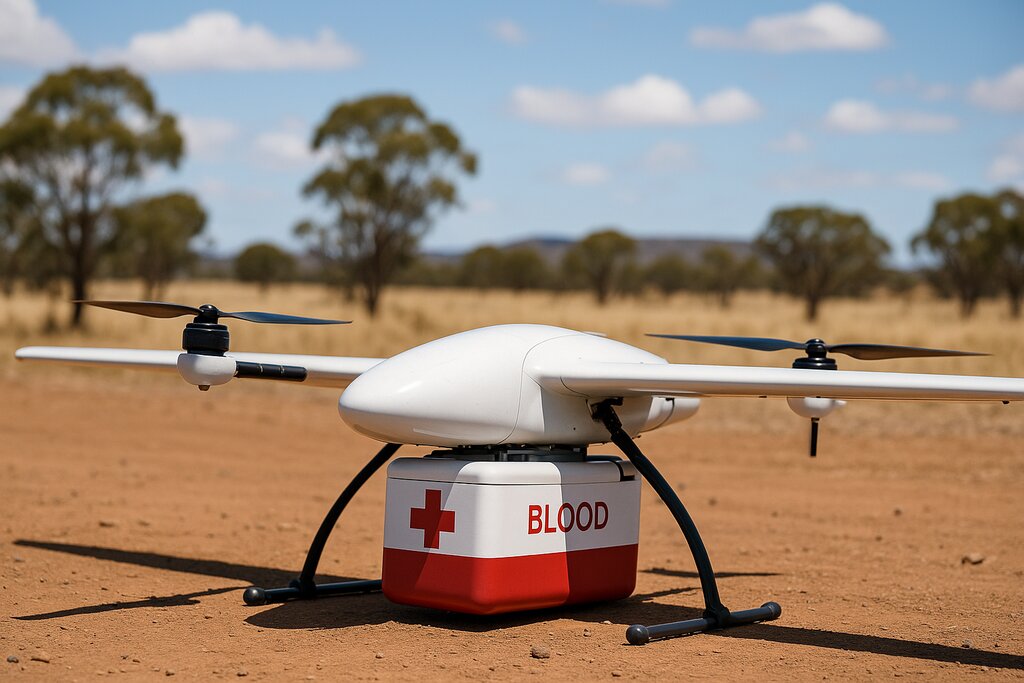
Drone blood delivery in Australia using medical transport drone

Drone technology is transforming industries across the globe, and healthcare logistics is no exception. One of the most remarkable advancements in recent years is drone blood delivery — a cutting-edge solution that addresses time-critical challenges in rural and emergency medicine. In Australia, where geography and vast distances often create barriers to prompt medical care, the implications are profound.

What Is Drone Blood Delivery?

Drone blood delivery is the process of transporting blood, blood products, and medical supplies using unmanned aerial vehicles (UAVs), or drones. While medical applications dominate here, suburban retail use cases are advancing quickly through companies such as Manna drone in Europe. This approach offers a rapid, efficient, and reliable alternative to traditional road or air transport — especially in remote or disaster-struck regions. Unlike standard couriers, drones can bypass traffic congestion, poor infrastructure, and adverse terrain. With appropriately regulated flight paths, blood can be flown from collection centres or hospitals directly to emergency sites, regional clinics, or disaster zones within minutes.

Why Is Drone Blood Delivery Needed in Australia?

Australia’s healthcare system is among the best in the world, but geography often presents a formidable challenge. Remote Indigenous communities, regional towns, and mining sites often lack immediate access to medical facilities. In trauma cases, delays in receiving blood can mean the difference between life and death. Current methods of delivering blood to rural areas involve road couriers, helicopters, or even charter flights — all of which are costly, logistically complicated, and weather-dependent. Drones offer a faster, more affordable, and environmentally sustainable alternative. Australia’s vast terrain, frequent natural disasters, and decentralised population centres make drone blood delivery an ideal solution for rapid-response healthcare logistics.

Challenges of Drone Blood Delivery

While promising, drone blood delivery is not without its hurdles. These include:

  • Regulatory barriers: CASA (Civil Aviation Safety Authority) regulations must be navigated carefully to operate drones beyond visual line of sight (BVLOS), particularly in controlled airspace or near hospitals.
  • Payload and temperature control: Blood products must be transported at specific temperatures. Drones need specialised containers that maintain thermal integrity during flight.
  • Flight reliability and safety: Blood is a precious resource. Delivery failures are not an option. Drone operators must demonstrate rigorous testing, redundancy, and reliability in their flight systems.
  • Community perception and noise: The public must accept and trust drone operations over populated or sensitive areas.
  • Integration with existing systems: Hospitals and blood banks require seamless integration with drone logistics — from dispatch to chain of custody.

Australian Case Studies and Early Trials

Several Australian states have begun exploring drone blood delivery trials. In regional areas, trial programs have demonstrated the feasibility of transporting blood and pathology samples between healthcare facilities using drones. These early projects have shown promising results, particularly in reducing delivery time, increasing reliability during extreme weather events, and maintaining proper temperature controls throughout the flight. These trials have opened the door for wider adoption, particularly as CASA evolves regulations to support BVLOS operations for essential services. With the right framework, drone logistics can be safely and effectively integrated into regional healthcare systems. Flying Glass offers drone consultancy services to assist healthcare providers, councils, and logistics companies interested in exploring such capabilities. We provide guidance on compliance, operations, equipment, and CASA approvals tailored for BVLOS and medical applications.

How Flying Glass Supports Drone Blood Delivery in Australia

At Flying Glass, we understand the complexities of using drones in sensitive and high-stakes environments. With decades of aviation experience and a CASA-certified Operator’s Certificate (OC), we help healthcare organisations and government bodies assess, implement, and operate drone solutions for blood and medical deliveries. Our services include:

  • Custom drone solution design: Selecting or modifying drones for thermal regulation and medical payload requirements
  • Flight planning and risk assessment: Including BVLOS permissions, safety mitigations, and redundancy protocols
  • CASA consultancy: End-to-end support for applications, compliance, and operational documentation
  • Training and operational support: RePL training, mission-specific pilot training, and ongoing operational support

Drone blood delivery in Australia using medical transport drone

Looking Ahead: The Future of Medical Drone Logistics

The global medical drone delivery market is expected to exceed AUD $1 billion within the next five years. As Australia grapples with ageing infrastructure, healthcare labour shortages, and increasing climate-related disruptions, drone blood delivery presents a forward-thinking, scalable solution. With CASA regulations evolving to support BVLOS and autonomous operations, the opportunity to scale these projects is growing rapidly. Integrating drones into the national health supply chain may soon become a reality — not just for emergencies, but for routine deliveries of blood, organs, and medications.

Why Choose Flying Glass as Your Drone Consultancy Partner?

Flying Glass is uniquely positioned to help bring drone blood delivery into the mainstream. Our team combines deep aviation knowledge, high-end drone cinematography expertise, and on-the-ground experience with regulatory bodies and technical operations. We don’t just advise — we partner with our clients to deliver real-world, commercially viable outcomes that save time, money, and lives. Whether you’re a hospital looking to trial drone deliveries or a council seeking flood-proof medical logistics, Flying Glass is here to help you every step of the way.

Contact Us to Explore Drone Blood Delivery

If you’re considering implementing a drone blood delivery program, we invite you to contact us today. Let’s discuss how our consultancy services can bring speed, safety, and innovation to your healthcare logistics.